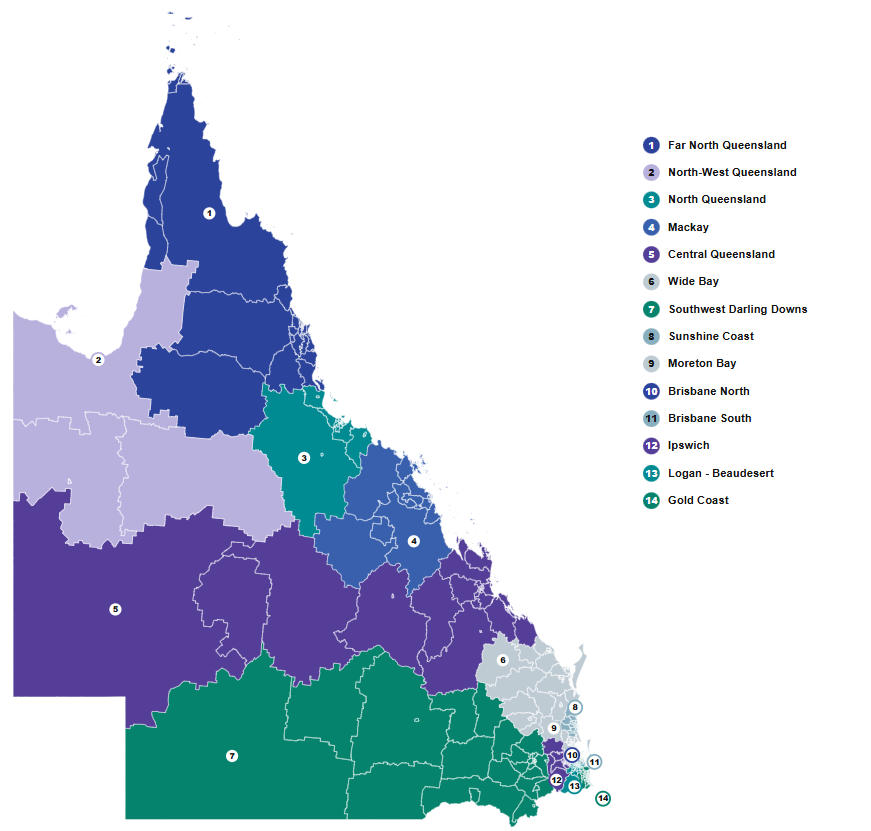
Queensland’s education and care workforce is often spoken about as one sector. The Institute’s regional intelligence profiles tell a more nuanced story: of one workforce, shaped by many different environments, people and realities across the State. While some regions are growing quickly, others are focused on sustainability, access and service continuity, with each carrying different workforce planning signals.
The Institute has developed regional intelligence profiles to provide a shared evidence base for workforce planning at a regional level. The profiles bring together service, workforce, child development, population and community data so local educators, services and stakeholders can see what is happening in their own region, not just across Queensland as a whole. They were created to support practical conversations about educator supply, service growth, access, quality, capability and local workforce priorities.
Across Queensland, almost 48,000 educators are supporting children and families across 3329 education and care services in 268,406 approved places. Behind that number are local realities that look very different region to region. Over the past two years some regions have seen strong growth, with Ipswich increasing by 19 services, Moreton Bay by 16 services, and Logan Beaudesert by 11 services, pointing to regions where growth is creating demand for educator supply, qualification pathways and leadership capacity. Far North Queensland recorded 7 fewer services and Darling Downs 9 fewer services over the same period, raising different questions about service sustainability, access and local workforce support.